
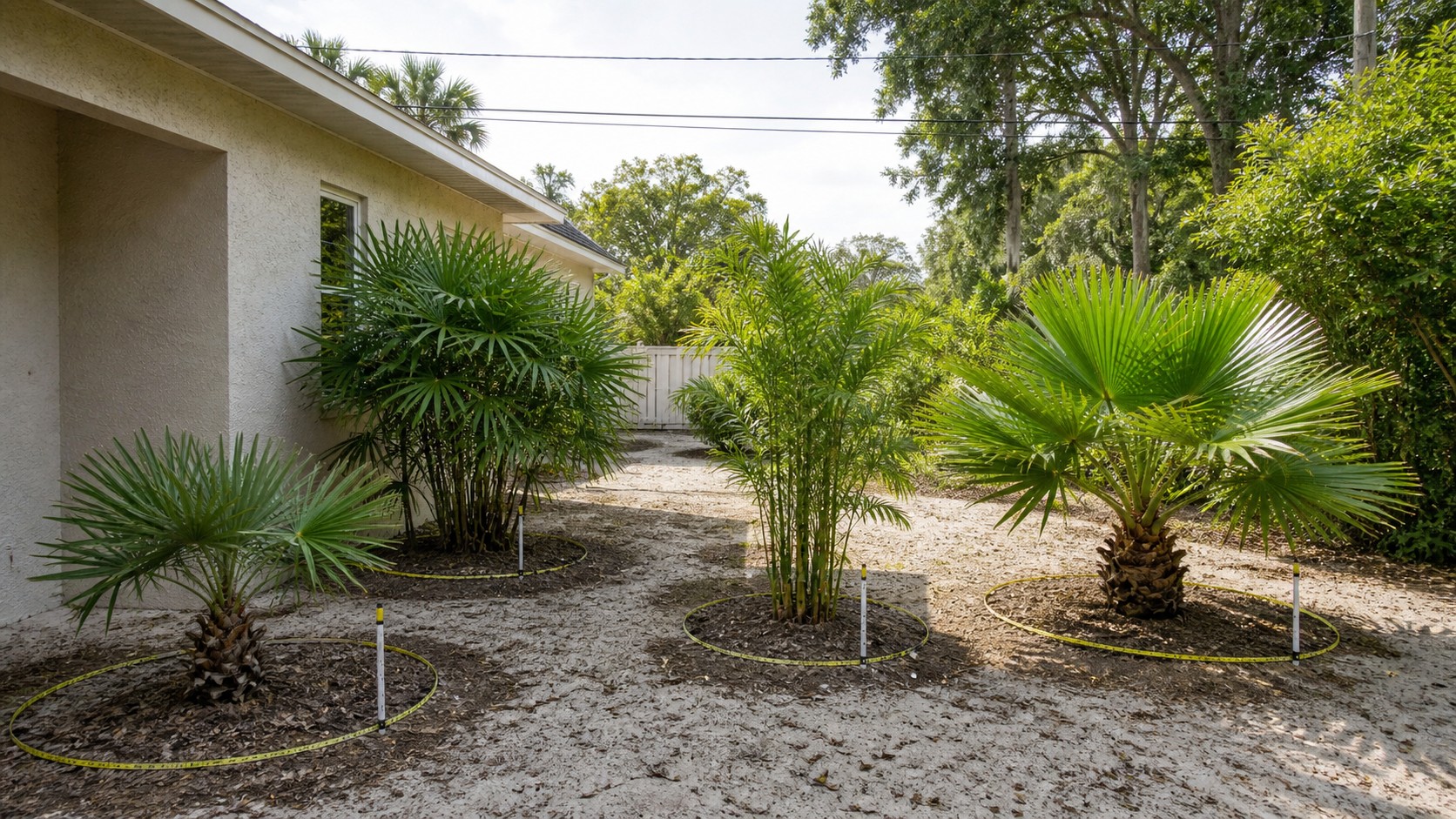
“Dwarf palm” is a shopping label, not a site plan. A species that stays ten feet tall can still spread fifteen feet, carry spines into a walkway, send clumping stems through a narrow bed, or fail after an Orlando cold snap. The correct question is whether the mature plant, its maintenance corridor, and its failure modes fit one measured bay.
Small height can hide a wide footprint
Measure the planting bay at ground level and at canopy height. Record wall, eave, window, condenser, meter, gate, drain, sidewalk, pool barrier, overhead line, and neighboring-space conflicts. Then draw the mature width from UF/IFAS guidance as a circle or clumping envelope—not as the current pot.
Central Florida examples make the trap clear. UF/IFAS lists dwarf sugar palm at a typical 10 feet high but 15 feet wide, saw palmetto at 6 by 12 feet, and European fan palm at 15 by 20 feet. Each can be described as low or compact relative to a 50-foot palm, yet none is automatically suitable for a narrow passage.
| UF/IFAS-listed palm | Typical H × W | Exposure or habit | Space decision |
|---|---|---|---|
| Dwarf bamboo palm | 5 × 3 ft | Clumping; requires shade; Zone 9a | Useful for a protected narrow bed if the three-foot canopy and service access fit |
| Hardy bamboo palm | 6 × 6 ft | Clumping; requires shade; Zone 9a | Needs more lateral room than its name suggests |
| Lady palm | 8 × 8 ft | Clumping; grows best in shade; Zone 9a | Allow stem renewal and access around the whole clump |
| Dwarf palmetto | 8 × 8 ft | Single stem; rarely forms a visible trunk; Zone 7a | Cold-hardy low fan form, but still an eight-foot-width plant |
| Needle palm | 6 × 6 ft | Clumping; shade; very cold hardy; trunk spines | Keep away from gates, play, pets, and hand-clearance routes |
| Dwarf sugar palm | 10 × 15 ft | Clumping; Zone 9b; stems die after fruiting | Needs a broad bed and a route for periodic stem management |
These are typical dimensions, not warranties. Cultivar, light, soil, water, and management can change form. Use botanical names in the quote and ask the supplier to document the exact material.
Shade palms and sun palms are not interchangeable
A north wall, live-oak canopy, screened enclosure edge, and open driveway create different light and cold conditions. UF/IFAS identifies dwarf bamboo palm, hardy bamboo palm, lady palm, slender lady palm, finger palm, and needle palm as shade-adapted choices in its Central Florida table. Putting them into reflected afternoon sun because the plant is small ignores the site requirement.
Map direct sun by season. Winter sun can reach beneath deciduous canopy while summer light disappears; a wall can reflect heat but also create a colder night pocket. Note roof runoff, wet-season saturation, irrigation overspray, and dry eave zones. A palm planted for shade aesthetics still needs a root zone that drains.
Do not solve a bad light match with permanent extra irrigation. Use the site’s current watering guidance to separate establishment allowances from routine landscape watering, and verify the jurisdiction and water source for the property.
Cold hardiness belongs in the purchase decision
Orlando is subtropical, not reliably frost-free. UF/IFAS says foxtail, pygmy date, triangle, and Alexandra palms may be marketed in Central Florida and may survive with damage in protected locations, but are not reliably hardy in most of the region. That is a different decision from whether a nursery currently sells them.
Specify the acceptable cold outcome. A specimen near an entry may be unacceptable if it repeatedly browns and requires months to recover. A collector plant in a warm enclosed courtyard may be an informed risk if the owner accepts protection and replacement. The design should name the microclimate evidence and contingency.
After a freeze, do not diagnose disease from uniform browning alone. UF/IFAS documents cold injury on sago—technically a cycad, not a true palm—and advises waiting until frost danger passes before removing damaged fronds. Species identification changes the diagnosis, which is another reason to keep botanical names in the property record.
Spines, fruit, and stem turnover change where a palm fits
A six-foot plant can still be hostile beside a gate. Needle palm carries trunk spines; several fan and date palms have spiny petioles. Keep armed foliage outside reach zones for children, pets, maintenance workers, pool users, meters, and door hardware. Draw the normal travel line and the full frond arc.
Clumping palms need a management rule. Decide whether the clump may widen naturally, whether selected stems can be removed, and how crews reach the center without damaging adjacent surfaces. Dwarf sugar palm has individual stems that die after fruiting, so access for that turnover belongs in the original layout.
Fruit and flowers can create litter, seedlings, wildlife activity, or slip conditions. Do not plant an attractive fruiting palm over pool deck, air-conditioning intake, drain, roof valley, or narrow entry without accepting that maintenance. The landscape design plan should show targets below as well as canopy spread.
Disease exposure argues for diversity
UF/IFAS warns that several common Central Florida palms have important disease exposure. Canary Island date, queen, and Mexican fan palms are highly susceptible to Fusarium wilt; date palms, cabbage palms, and wild date palms are also highly susceptible to a documented phytoplasma decline. All palms can be affected by trunk rots and nutritional disorders.
A row of one palm species can turn one susceptibility into a repeated landscape failure. UF/IFAS recommends planting a variety of palm species or mixing palms with hardwood trees to reduce epidemic risk. On a compact lot, that may mean one well-placed palm within a mixed planting rather than a monoculture screen.
Ask the supplier about provenance and current symptoms. Reject a palm with an unclear central spear, damaged trunk, buried root initiation zone, active pest evidence, or a root ball that cannot be placed at the correct depth. Photograph the plant at delivery and after installation.
Reserve the maintenance corridor at mature size
Keep mulch and soil away from the trunk base and do not raise grade around an existing palm. UF/IFAS recommends a planting hole at the root-ball depth and roughly twice its diameter, with about one inch of soil covering the top of the root ball. It reports no benefit from amending the backfill with organic matter for palm installation.
Plan watering to reach the bottom of the root ball during establishment, then adjust by soil, weather, exposure, and rooting rather than a permanent calendar assumption. Put emitters and shutoffs where they remain visible as the clump expands. Avoid lawn fertilizer overlap and use palm-specific diagnosis when symptoms appear.
The service corridor should allow inspection of the spear, lower trunk, irrigation, wall, roof edge, and utility equipment. It also prevents a future crew from cutting healthy foliage solely because the original planting bay was too small.
Street-side planting requires an ownership check
The grassy strip near an Orlando street may be public right-of-way, and the responsible agency is not always the City. Orlando requires a right-of-way permit for work in the street, beneath a sidewalk, or in the grassy area beside the street; its page warns that some rights of way are controlled by other jurisdictions.
Do not dig or plant until jurisdiction, utilities, sight lines, sidewalks, drainage, and approval are confirmed. The City’s street-tree program uses site inspection, available space, underground utilities, and a Right Tree, Right Place policy to choose locations and species. A privately purchased “small palm” does not override that review.
Keep palms out from under overhead lines based on ultimate height, not purchase height. UF/IFAS explicitly makes overhead power lines and mature spread first-order palm selection questions.
Accept the planted bay against the scale drawing
Before installation, stake the mature canopy and service outlines on the ground. Walk the gate, sidewalk, pool edge, equipment route, window, and neighboring boundary. After planting, verify root-ball depth, vertical alignment, irrigation reach, drainage, clearances, mulch placement, and botanical identity.
Bank a photograph of the label, the measured bay, the planting depth, and the final site. Schedule review after establishment and again when the canopy reaches half its expected width. Use the written quote request to include botanical name, mature H × W, light, hardiness, spine and litter constraints, utility boundary, and maintenance corridor.
Central Florida small-palm Sources
- UF/IFAS: Ornamental Palms for Central Florida, mature size and site table
- UF/IFAS Extension Orange County: Palms for Central Florida
- UF/IFAS: sago palm cold injury and pest diagnosis
- City of Orlando: right-of-way work and jurisdiction check
- City of Orlando: site, utility, and Right Tree, Right Place selection