
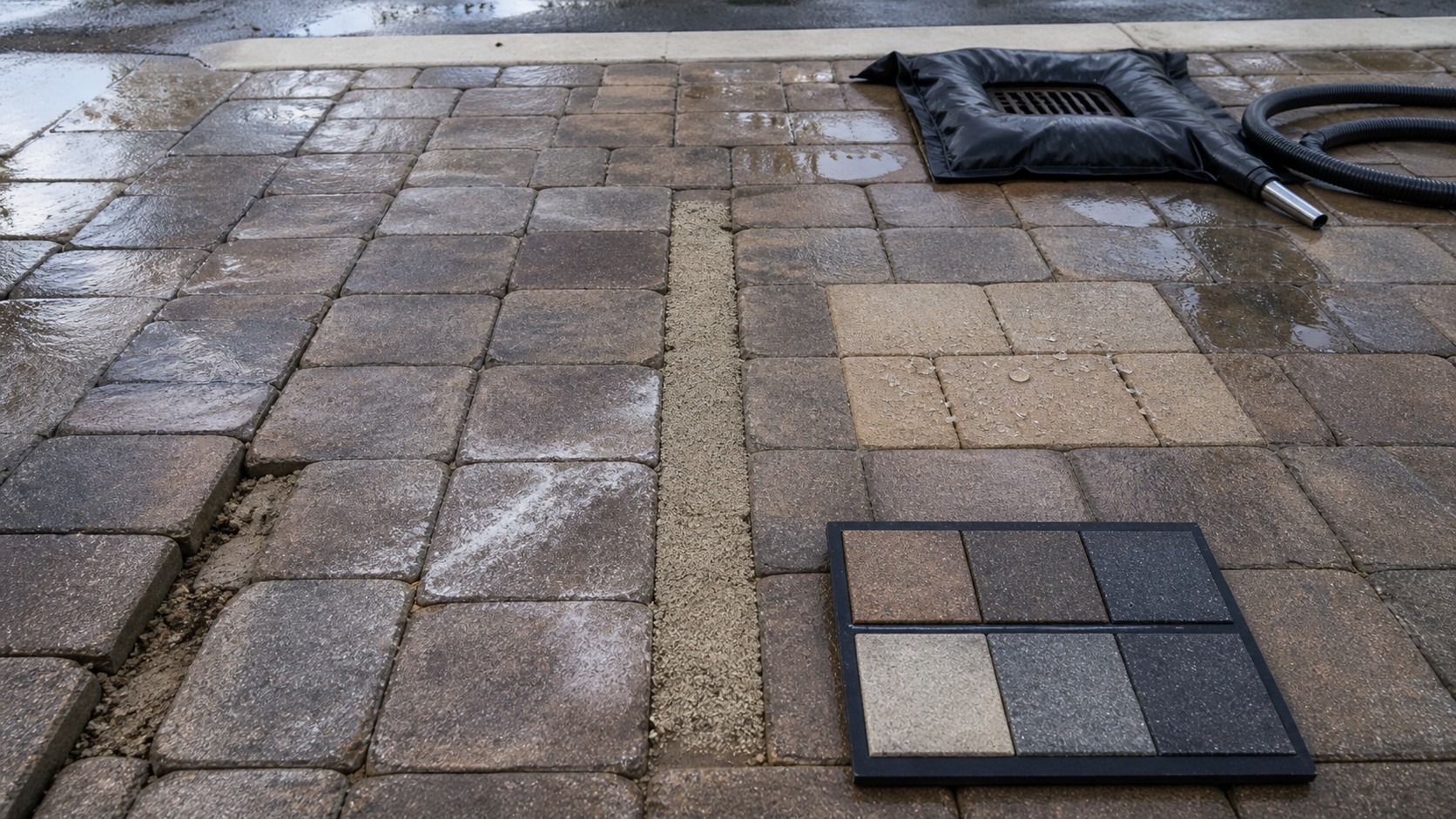
Sealing is not the first step in paver maintenance. On an Orlando driveway, patio, or pool deck, a glossy sample can distract from sunken units, eroded joints, trapped moisture, active efflorescence, poor drainage, or a cleaner that was never fully neutralized. Once covered, those conditions may become harder and more expensive to correct.
Sealer is the last decision, not the first service
Map the pavement in dry weather and after an ordinary rain. Mark rocking pavers, lips, wheel-path settlement, open joints, loose edges, ponding, algae, white haze, oil, rust, irrigation deposits, tree litter, and older coating. Photograph each condition at the same angle and note whether it changes after the surface dries.
Separate structural and visual defects. A sealer can affect absorption, stain resistance, color, sheen, and joint behavior. It cannot rebuild a base, restore edge restraint, correct reverse slope, or level an unsafe lip. The broader Orlando hardscape scope should own those physical repairs before surface treatment begins.
| Observed condition | First action | Why sealing now is unsupported |
|---|---|---|
| Rocking, sunken, or separated units | Lift a bounded area and inspect bedding, base, edge, roots, and water path | A coating cannot restore interlock or elevation |
| White crystalline or cloudy haze | Identify efflorescence versus residue or coating failure | The appearance can be trapped or intensified |
| Joint sand depleted below the chamfer | Find erosion source; clean and refill with an approved joint system | Open joints remain a pavement defect |
| Dark damp areas long after rain | Trace irrigation, drainage, shade, bedding saturation, or groundwater | Residual moisture can interfere with curing and appearance |
| Existing film peels or turns white | Identify the old product and failure mechanism; design a compatible removal test | Another coat can compound incompatibility |
| Pool-deck surface feels slick when wet | Measure and test the surface system under wet use conditions | Added film or gloss may change traction |
A white haze is not a structural diagnosis
The Concrete Masonry & Hardscapes Association describes efflorescence as calcium carbonate left when moisture carries soluble material to the surface and evaporates. It is an aesthetic condition, not proof that paver pigment is fading or the pavement is structurally failing. Its location, recurrence, and moisture source still matter.
Do not attack every white mark with acid. Irrigation scale, cleaner residue, failed sealer, grout, and efflorescence can look similar. Identify the paver and any existing coating, then use the manufacturer-approved cleaner and a small inconspicuous test. Careless cleaning can discolor or damage concrete pavers.
If moisture repeatedly drives haze, sealing without resolving the water path can create a cycle of whitening or trapped appearance. CMHA recommends considering a breathable sealer where efflorescence recurrence is a concern, but product type, substrate, joint material, old coating, application rate, and local exposure all require compatibility evidence.
Clean by contaminant and capture the water
Oil, rust, leaf tannin, algae, paint, efflorescence, and old coating are different chemistries. Write a treatment for each stain rather than specifying “pressure wash.” High pressure can remove joint sand, mark the paver face, push contamination, and drive water deeper. Nozzle, pressure, distance, flow, dwell time, agitation, rinse, and recovery should be part of the method.
Before washing, map every drain, inlet, curb, lawn edge, pool, pond, and low point. The City of Orlando’s stormwater guidance tells pressure-washing operations to identify storm drains and use controls such as drain covers, berms, containment areas, vacuums, pumps, hoses, separators, and holding tanks to contain and collect wash water.
That guidance is not a universal disposal approval. The chosen cleaner, stripped coating, oil, sediment, algae, and other contaminants affect the lawful route. Stop flow before it reaches a storm inlet, water body, neighboring property, or pool. Bank the product safety information and recovery plan with the job.
Restore joints only after the surface is ready
Joint loss can come from concentrated runoff, pressure washing, ants, traffic, edge movement, inadequate material, or an installation defect. Correct the cause first. Remove loose material to the depth required by the selected system without disturbing sound bedding, then install dry, compatible joint material to the specified level.
Polymeric or other stabilizing products are not interchangeable with ordinary joint sand. Confirm paver type, joint width and depth, drainage, slope, cleaning method, compaction, activation water, weather window, cure time, and sealer compatibility. Excess material on the paver face can become a haze once activated.
Do not describe joint stabilization as structural repair. If units move under load or the edge spreads, the underlying pavement needs correction. The Orlando rainy season makes water management especially visible: observe the repaired area through a normal storm before covering it.
Choose performance before finish
Start by naming the intended result. A penetrating water repellent, stain-resistant treatment, joint-stabilizing system, color enhancer, matte film, and high-gloss film change different properties. “Wet look” describes appearance, not vapor transmission, ultraviolet stability, chemical resistance, recoat procedure, or traction.
CMHA notes that silane and siloxane water repellents can reduce moisture entry while allowing vapor release and can provide a flat, low-gloss appearance. It also notes that those materials do not inherently resist petroleum staining unless formulated with suitable additives. Product claims must be checked against the actual paver, stain exposure, and old treatment.
For a pool deck, wet-surface behavior is a hard gate. Florida’s current building framework uses slip-resistant requirements in pool contexts, but the exact code path differs between private and public facilities and by feature. Do not promise that an additive or texture is “code compliant” without the applicable project standard, product test data, application rate, and inspection authority. Review the site’s pool-deck material comparison for the underlying surface decision.
The test patch must survive an Orlando rain cycle
A useful patch includes the whole proposed system: cleaner, rinse, drying period, joint material, sealer, application rate, number of coats, and curing conditions. Place it where the paver type and exposure represent the project, but not where a failure creates a safety hazard.
Record air and surface conditions, recent rain, irrigation shutdown, substrate moisture method, batch numbers, coverage, and start and finish time. Judge the patch when dry, under direct sun, in shade, after wetting, and after at least one ordinary rain-and-dry cycle. Look for whitening, bubbles, roller marks, blotching, tack, sand pickup, uneven color, and unexpected gloss.
Use a separate wet-traction evaluation on walk and pool areas. A patch that looks even but feels less secure under wet footwear has failed the intended use. Photograph with fixed exposure so shine is not exaggerated by a phone’s automatic settings.
Set a weather window that includes drying
The application window begins before the coating is opened. It includes controlled cleaning, rinse removal, complete substrate and joint drying, installation temperature, humidity, dew, irrigation shutdown, rain exclusion, and cure time before foot or vehicle traffic.
Do not use a universal “wait 24 hours” rule. Paver porosity, shade, joint depth, old coating, recent rain, and humidity change drying. Use the selected manufacturer’s written moisture and weather limits, then verify rather than infer. Protect the work from automatic sprinklers and roof runoff throughout curing.
Phase the site so occupants retain a safe route. Place barriers without blocking drainage or emergency access. If the project adjoins planting, coordinate irrigation and chemical protection through the landscape plan.
Accept the pavement, not the sales sample
At closeout, inspect from several sun angles and after full cure. Confirm uniform appearance within the agreed natural variation, dry joints, clean edges, open drains, no coating on walls or plants, no residue in the street, and no new ponding. Run a controlled water test and repeat the wet-traction check where people walk.
The receipt should identify repaired areas, cleaners, joint material, sealer, batch, coverage, coats, weather, drying evidence, test-patch approval, wash-water handling, traffic reopening, maintenance method, and future recoat or removal path. Use the written quote request to attach that evidence instead of ordering “seal all pavers.”